
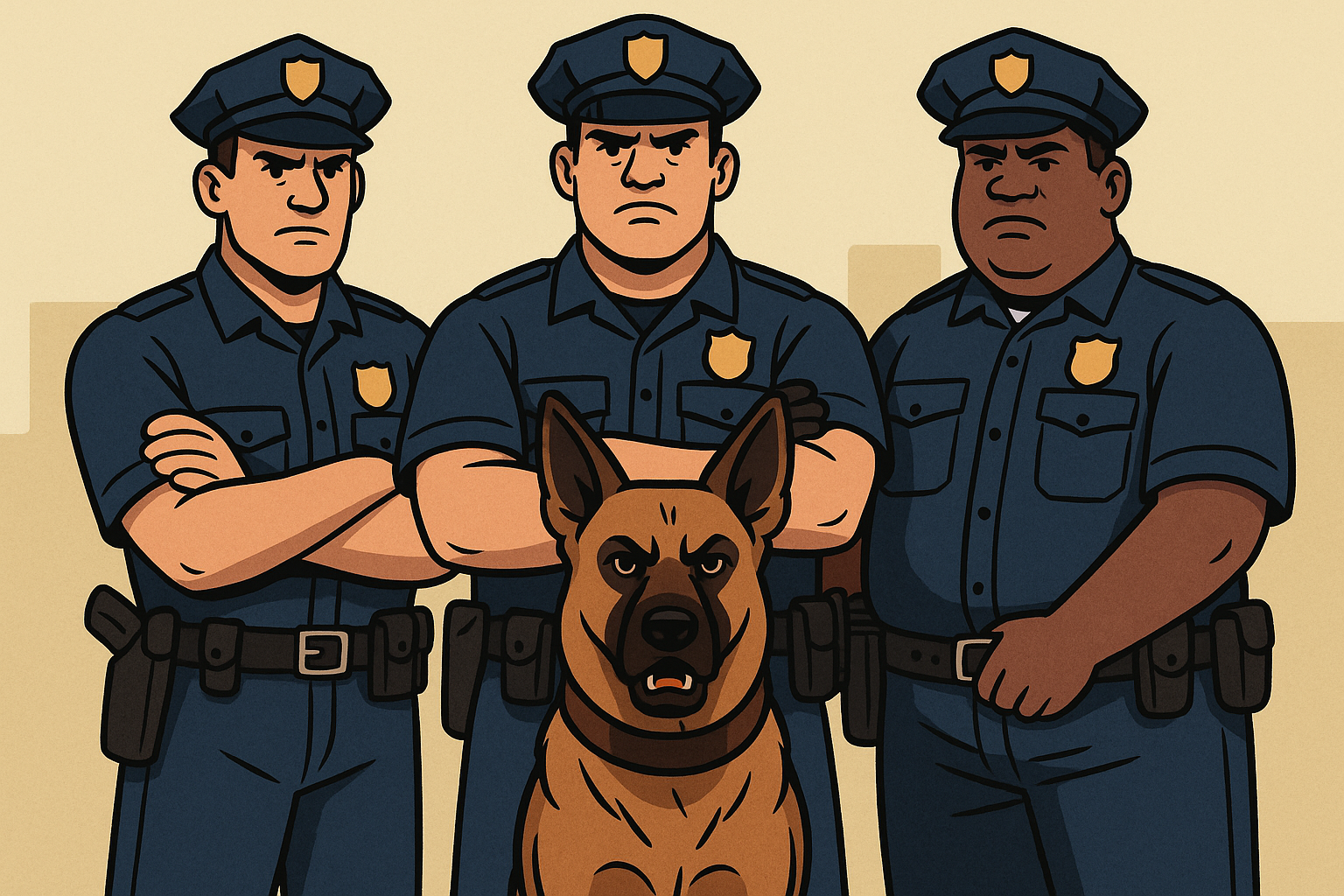
When you think of the “police,” what comes to mind? Maybe a ’70s rock band, or maybe a group of people in uniform tasked with enforcing the law. The reality is, in both cases, a key component is often overlooked. Of course, I’m talking about the dogs that make up almost every law enforcement agency in this country.
Now, don’t get me wrong, I’m an animal lover, and I don’t want anyone to misinterpret my words here. That being said, it is my personal and professional opinion that the dogs who “put on the uniform” and go to work every day are held to an abysmally low professional standard. That’s not their fault. They are simply doing what they’ve been trained to do. The real issue lies with the humans who handle them, officers who sometimes feign ignorance, dismiss responsibility, or in the worst cases, manipulate or obscure the actions of their K-9 partners to suit their purposes.
Canines at work.
Let’s talk for a second about the wide variety of ways police dogs are used. The two most common categories are:
- Contraband-sniffing dogs — used to detect drugs, firearms, or explosives.
- Apprehension dogs — tasked with, for lack of a better word, “apprehending” suspects. (I use that term tongue-in-cheek, because I wouldn’t necessarily consider a 90-pound German Shepherd with two-inch canines clamped down on your neck as mere “apprehension.” But I digress.)
Both of these law enforcement dogs are ones that an ordinary person might realistically encounter in daily life. And both trigger fact patterns and legal questions that I’ve chosen to devote my professional career to taking on.
The risks to the public at large.
On the one hand, there is the very real possibility of serious bodily injury at the jaws of an animal. While there is nuance in the fact that these dogs are treated as “police officers” and therefore have certain immunities that civilian dogs do not, the fact remains that if you are injured, you may still be entitled to civil compensation under the right set of facts.
On the other hand, because these dogs are considered police officers, their conduct (and the conduct of their handlers) is also subject to the same constitutional protections that govern all law enforcement. That means:
- The Fourth Amendment, which protects against unreasonable searches and seizures — including the use of excessive force.
- The Fifth Amendment, which guarantees the right to due process.
When a police dog bites, holds, or “alerts,” the law doesn’t just ask “Was it the dog?” it asks “Was this a reasonable use of force by the government?”
An example.
I recently came across the story of a California man who was the victim of a shocking dog attack. From the available facts, the man was suspected of unarmed theft of alcohol from a local store. (Keep in mind, this is essentially a petty theft, the kind of crime that often results in probation, if it’s even prosecuted at all.)
In an attempt to apprehend him, police released their canine unit. The man had no real chance. The dog lunged at his neck and clamped down.
At that point, for all intents and purposes, the man was detained, he was not free to leave of his own will, as he had a dog locked onto his neck. Because he was seized, his constitutional rights under the Fourth Amendment automatically applied. The Constitution requires that no seizure by the government be “unreasonable,” and this principle underlies the doctrine of excessive force. Courts use legal tests to determine what qualifies as excessive force, but for our purposes, let’s use common sense:
Should someone suspected of stealing alcohol be subjected to a dog bite to the neck in order to stop them from fleeing?
I don’t know about you, but that’s not the kind of society I want to live in. And in fact, courts often agree. The deployment of a police dog in this scenario was very likely excessive force. But it didn’t end there.
According to court records, the dog remained latched onto the man’s neck for a full minute, ignoring officer commands to release more than 20 times. As a result, the man suffered devastating injuries that, five years later, still affect him. Fortunately, he hired a competent attorney who recognized not only the clear constitutional violation but also the entitlement to civil compensation. The case settled for $1.6 million.
This was not a “run of the mill” police encounter. It was an unprovoked, unwarranted assault that fell outside the scope of the officers’ duties, and the usual immunity protections simply did not apply. (If you’d like to read more, the original article contains images and video that I will not show here.)
Conclusion
This case is surely an extreme example. But it highlights just how thin the line can be between legitimate law enforcement and conduct that crosses into unreasonableness, the very line the Constitution exists to protect.
If you ever find yourself in a situation where you are injured in an encounter with a police dog, you should immediately speak with an attorney. Whether or not the dog made physical contact, the standards that govern K-9 officers remain far too low, and the consequences can be life-changing.
If you are facing criminal charges in Ventura County, especially where an unlawful search, a bad stop, or another civil rights violation may be part of the story, learn more about my criminal defense practice. The initial consultation is always free.
-Alex Murad, Esq.